Quantitative Forecasting and Scenario Engine
A driver-based financial model connecting account-level assumptions, operating drivers, entity behavior, and balance-sheet mechanics into one self-balancing forecast environment.
- GL + drivers
- Assumption layer
- Forecast engine
- Validation suite
- Statements
- Audit trail
The operational problem
Management needed a forward view of the balance sheet and cash position that could survive questioning: not one number, but the assumptions, drivers, and mechanics behind it, at the account level, across entities.
Why the existing process failed
The prior approach flattened complexity into single ratios. It produced a number, but not a defensible one: assumptions were implicit, entity behavior was averaged away, and when the result was challenged there was no chain of reasoning to show.
What was built
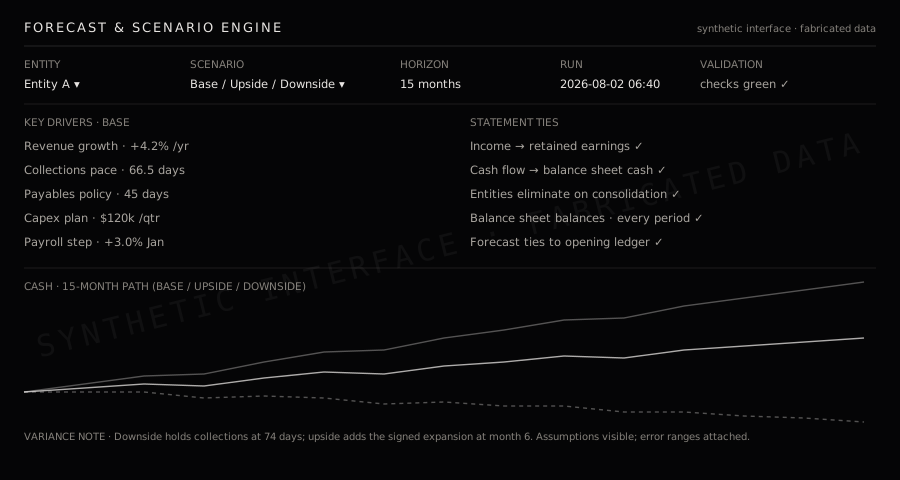
A driver-based forecasting environment where account-level assumptions, operating drivers, and entity mechanics feed a self-balancing statement model. Statistical estimation supports drivers where history justifies it; explicit business rules carry the rest. Scenario overlays sit on top of the engine rather than replacing it, so alternative assumptions can be compared against the same mechanical core.
What the system automates, calculates, and controls
Account-level projection, inter-entity balancing, scenario comparison, and the reconciliation of forecast output back to source data. The system preserves the equations, dependencies, and validations required to defend the result, which is the actual product; the forecast is just its output.
Where human judgment remains
Assumption setting, scenario selection, and the final management call. The engine makes the consequences of assumptions visible; it does not choose them.
How correctness was tested
A validation suite checks structural ties, entity balancing, and each account’s forward path against its own history, so an implausible trajectory fails loudly instead of hiding in a total. Statistical drivers were backtested against actuals before being trusted.
What changed
Forecast conversations moved from defending a number to examining assumptions. Review time concentrates on judgment rather than arithmetic.
Disclosure
This is an internal system built inside an aerospace environment. Employer, program, and quantitative details are withheld. The architecture and control pattern are described because they are the reusable engineering.
Related service: Quantitative and financial models
Methods and research context
- Forecasting and model validation Implemented in this system
- Model explainability Considered during system design